
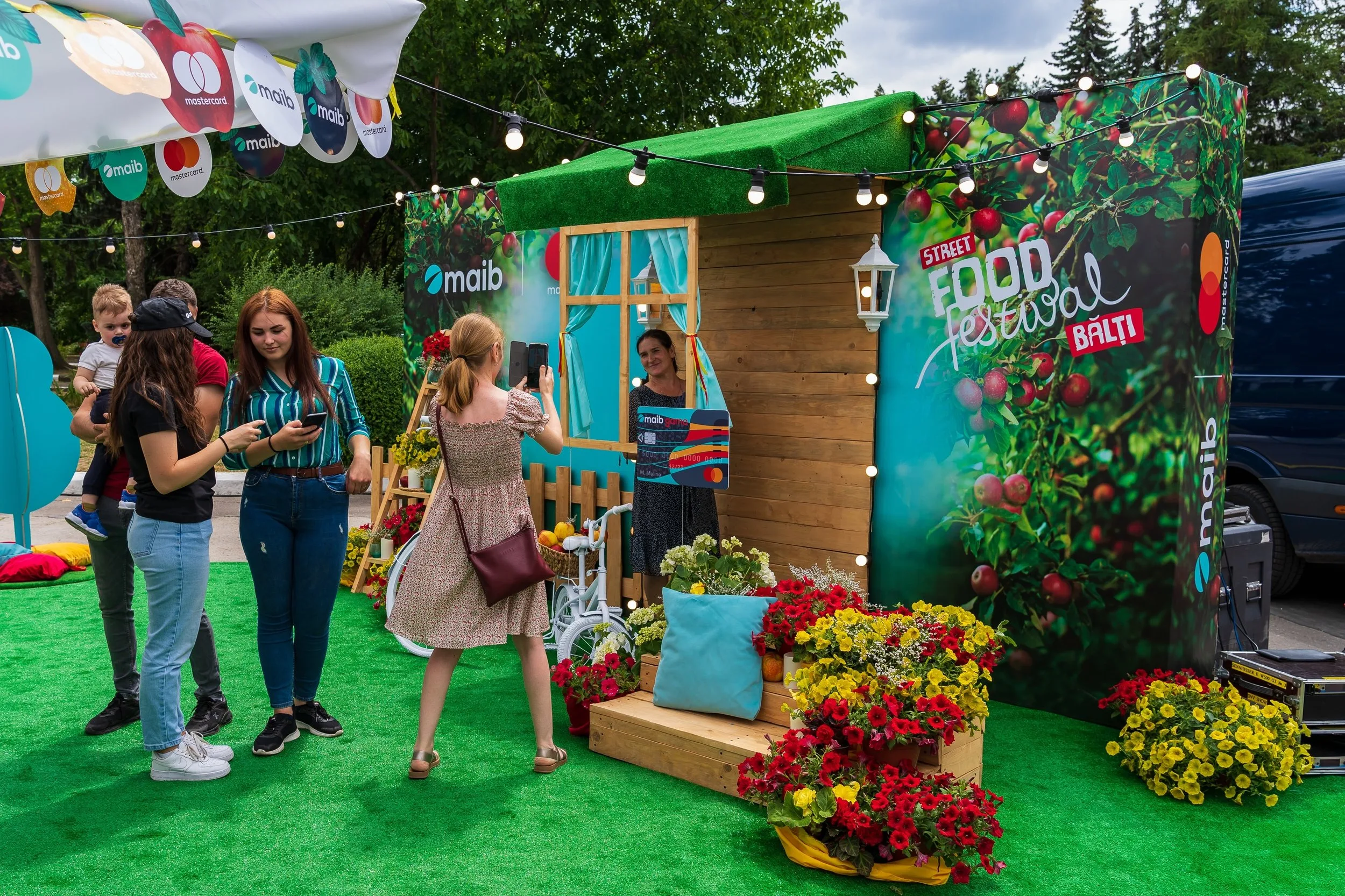
At Seeker, we’re seeing increasing demand for experiences that move beyond passive attendance into active participation, from scavenger hunts to interactive trails and gamified activations. Experiential marketing isn’t just growing, it’s outperforming everything. The stats in 2026 show it is solidifying its position as the premier marketing strategy to build trust and brand loyalty.
That move from passive attendance to active participation is exactly what separates the standout SXSW brand activations from the forgettable ones — the brands that give people something to do, not just something to see, are the ones that consistently earn the coverage and recall these numbers describe.
Methodology
This report compiles experiential marketing statistics from publicly available industry reports.
What Is Experiential Marketing?
Experiential marketing is a strategy that focuses on creating memorable, immersive experiences for consumers. Rather than relying on traditional advertising methods, experiential marketing engages people directly, encouraging them to interact with a brand in a way that fosters emotional connections and long-term loyalty. These experiences can range from pop-up events and interactive installations to brand activations and product sampling, all designed to build a genuine connection between brand and audience.
While most channels optimize for a single outcome (clicks, impressions, or conversions), experiential marketing delivers across the full funnel: attention, emotion, memory, and action.
Below is a comprehensive, data-backed breakdown of 26 experiential marketing statistics, organized by what actually drives results.
Statistics On Why Experiential Marketing Is Effective
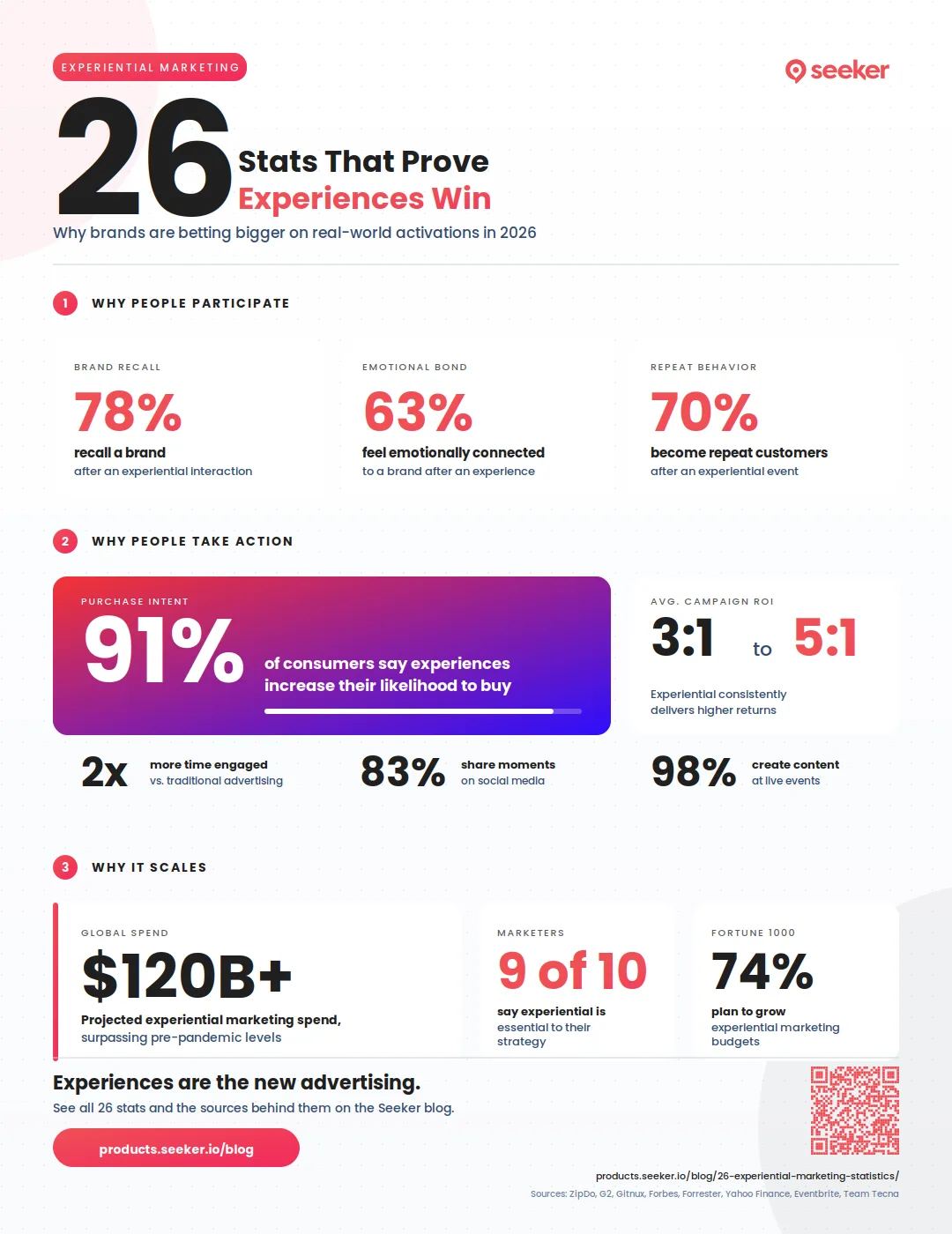
78% of consumers can recall a brand after an experiential interaction
According to ZipDo, experiential campaigns significantly outperform traditional advertising in brand recall because they engage multiple senses and create memorable touchpoints.
Brand recall is one of the hardest metrics to move in modern marketing as most digital ads are forgotten within seconds. The fact that nearly 8 in 10 consumers remember a brand after an experiential interaction speaks to how fundamentally different this channel is. When people do something with a brand rather than just see it, memory formation is deeper and more durable.
63% of consumers feel emotionally connected to a brand after an experience
ZipDo also reports that experiential marketing creates emotional resonance, which is a key driver of long-term brand loyalty and trust.
Emotional connection is what separates a customer from a loyal advocate. Most marketing channels optimize for attention. Experiential marketing optimizes for feeling. That distinction matters because consumers who feel emotionally connected to a brand spend more, stay longer, and refer others at a significantly higher rate than those who simply recognize it.
64% of consumers retain a positive impression for at least a month after an experience
According to Kadence International, experiential marketing creates a lasting brand halo effect that extends well beyond the initial interaction.
This is the compounding power of experiential marketing. While a digital ad might drive a click in the moment, a well-executed brand experience generates residual goodwill that influences purchasing decisions weeks later. That extended shelf life makes experiential marketing one of the few channels where a single touchpoint can do the work of many.
77% of marketers say experiential marketing increases brand awareness
Data from G2 highlights that marketers see experiences as a top driver of meaningful brand awareness, not just impressions.
Practitioner consensus at this scale carries weight. When nearly 8 in 10 marketers across industries, budgets, and audience types identify experiential as a primary driver of brand awareness, it reflects accumulated campaign evidence rather than theoretical preference. This figure also points to a broader industry reclassification of experiential marketing from a tactical add-on to a core awareness channel.
70% of attendees become repeat customers after an experiential event
According to Gitnux, experiential marketing plays a major role in shaping repeat behavior and long-term customer value.
Customer retention is widely recognized as more cost-efficient than acquisition, and this statistic positions experiential marketing as a meaningful retention instrument, not solely an acquisition play. A 70% repeat customer rate among event attendees represents a substantial downstream revenue impact that is rarely captured in single-event ROI calculations.
Harvard Business School research finds that 66% of companies say their community significantly impacts customer retention, which helps explain why so many experiential campaigns are designed explicitly to deepen community engagement rather than just generate impressions.
65% of consumers say live experiences help them understand products better than any other channel
Gitnux also reports that hands-on experiences improve product comprehension more effectively than digital or traditional formats.
Product comprehension is a critical but often overlooked conversion variable. Confusion, skepticism, or insufficient product knowledge at the consideration stage are among the most common barriers to purchase. Live experiences remove those barriers directly through demonstration, interaction, and real-time question resolution, in ways that static content and digital advertising cannot replicate.
Statistics On How Experiential Marketing Drives Action
Experiential marketing campaigns deliver an average 3:1 to 5:1 ROI
According to Union, experiential marketing consistently delivers strong returns due to deeper engagement and higher conversion rates.
This ROI range reflects the full-funnel impact of experiential campaigns, which generate returns not only through direct event conversions but through downstream effects including earned media, social amplification, word-of-mouth referrals, and repeat purchasing.
The breadth of formats that deliver these returns — from pop-ups and product launches to immersive fan experiences — is captured in our roundup of brand activation examples, which covers 18 winning executions from 2019 through 2026.
91% of consumers say experiences increase their likelihood to buy
Research from Union shows that immersive brand experiences directly influence purchase intent by strengthening emotional engagement.
Purchase intent at this scale, reported by nine out of ten consumers, represents one of the strongest channel-level conversion signals in modern marketing research. The mechanism is well-documented: participation-based interactions create emotional context around a brand, which lowers decision-making friction and increases the cognitive salience of that brand at the point of purchase.
85% of consumers are more likely to purchase after participating in a brand experience
According to Forbes, consumers who engage in branded experiences are significantly more likely to convert.
Where the preceding statistic measures intent, this figure moves closer to behavioral outcome. An 85% lift in purchase likelihood among participants establishes experiential marketing not only as a brand-building channel but as a direct sales driver.
Consumers spend 2x more time engaging with experiential activations vs traditional advertising
ZipDo highlights that experiential marketing captures significantly more attention, one of the most valuable metrics in modern marketing.
83% of consumers are more likely to share experiential moments on social media
According to ZipDo, experiential marketing is inherently shareable, turning participants into content creators and extending campaign reach through credible peer distribution.
38% of attendees share content in real-time during events
Gitnux reports that real-time sharing transforms experiential into a live distribution channel, extending reach far beyond physical attendance.
52% of consumers become brand advocates after a positive experience
Also according to ZipDo, experiential marketing drives advocacy at rates few other channels can match, with significant implications for customer acquisition costs and long-term brand equity.
98% of consumers create digital or social content at events
Data from Team Tecna shows near-universal content creation, meaning the effective reach of an activation extends across every network reached by participant-generated content.
87% of consumers say live events make them feel more connected to a brand
Team Tecna also highlights the role of experiential in building deeper brand relationships, a leading indicator of loyalty and a predictor of long-term revenue performance.
72% of millennials prefer experiential marketing over traditional advertising
According to Eventbrite, younger audiences prioritize experiences over interruptions, a structural demand shift that will continue to influence channel investment for years ahead.
Those purchase-intent numbers are precisely why event marketing has grown into a $1.46 trillion global industry in 2026 — brands that turn a live experience into a structured, documented campaign consistently outperform those running the event as a standalone tactic.
Statistics On Why Experiential Marketing Scales Beyond the Moment
92% of marketers plan to strengthen post-event follow-up to improve experiential marketing ROI
This stat from Forrester reveals a major shift: marketers increasingly focus on what happens after the experience, capturing data, nurturing leads, and extending engagement beyond the moment.
Experiential marketing can influence up to 83% of tourism demand in destination markets
Research published on arXiv shows that experiential strategies play a major role in driving tourism and local economic activity, positioning experience design as a direct economic lever for DMOs and tourism boards.
9 out of 10 marketers say experiential marketing is essential to their strategy
According to G2, experiential marketing has become a core pillar of modern marketing strategies, no longer a supplementary tactic but integral to planning regardless of budget.
77% of marketers say live events are their most effective marketing channel
Data from Team Tecna shows live experiences outperform many traditional and digital channels, offering voluntary, undivided consumer attention in a controlled brand context.
78% of organizers rank in-person events as their top-performing tactic
According to Bizzabo, even in B2B environments, in-person experiences drive the strongest results, generating relationship depth that remote formats have not replicated at equivalent rates.
74% of Fortune 1000 marketers plan to increase experiential marketing budgets
G2 reports that enterprise-level brands are significantly increasing experiential investment, a signal of demonstrated return rather than speculative enthusiasm.
51% of brands plan to increase experiential marketing investment through 2026
According to Newbridge Marketing Group, more than half of brands are doubling down on experiences as a long-term strategy, confirming experiential has cleared the threshold from emerging channel to established strategic priority.
Global experiential marketing spend is projected to exceed $120 billion
Yahoo Finance estimates experiential marketing investment will surpass pre-pandemic levels, confirming accelerated growth momentum driven by both consumer demand and brand confidence in measurable return.
Turning Insights Into Action
The stats are consistent across sources: experiential marketing outperforms on awareness, purchase intent, loyalty, and advocacy. The brands executing best are creating measurable, scalable experiences that people actually want to participate in.
A strong real-world example: the LG Innovation Experience, a touring mall activation built on Seeker XP that turned a 20×20 installation into a gamified, badge-earning journey across multiple Canadian shopping centers, combining product discovery with participation mechanics that drove dwell time and first-party data collection at scale.
For a different industry application, Grange’s model home digital passport used Seeker XP to turn a nine-builder model home park into a QR code-powered, badge-collecting journey where prospective homebuyers had a room-by-room mission and a $2,500 prize draw to keep them exploring through every home.
Seeker XP is built specifically to help destinations, event organizers, and brands launch high-performing experiential campaigns using digital passports, gamification, and real-time engagement tracking. Book a demo to see what that looks like for your program.